Moving to a Zero-Tax Country Means Nothing If Your Exit Bill Is Six Figures
You've done the math on Portugal, Dubai, or Singapore. You know the tax rate you'd pay there. What you haven't calculated is the tax your current country charges you for leaving — on wealth you haven't even sold yet.
The US taxes unrealized gains when you renounce citizenship. Canada and Australia tax them automatically when you cease residency. Norway, France, Germany, Denmark, Spain, the Netherlands, Austria, and South Africa all have their own versions. And most people discover these rules after they've already booked the flight, signed the lease, and told their employer.
This is the pre-departure planning guide for anyone with assets who is considering an international move. It covers 13 countries, the 18-24 month planning timeline that advisors use, and the specific traps — like double taxation — that turn a manageable departure into a six-figure bill.
Who This Is For
This guide is for people with real assets who are 6-24 months from an international relocation and need an actionable plan, not another article explaining what an exit tax is:
- FIRE movement early retirees — you've hit your number and want to move somewhere cheaper, but your portfolio of index funds and a paid-off house puts you above the exit tax threshold in your country
- Tech workers with RSU-heavy compensation — a company IPO or internal transfer to Singapore, Dubai, or Lisbon means your unvested equity creates acute exit tax exposure that's tied to a vesting schedule you can't control
- Business owners planning a sale — you want to relocate before a liquidity event, but moving at the wrong time means your government taxes the gain before the buyer's wire even hits your account
- US citizens considering renunciation — the renunciation fee drops from $2,350 to $450 on April 13, 2026, and you need to know whether you'll be classified as a "covered expatriate" subject to the mark-to-market exit tax
- Dual citizens and "accidental Americans" — your foreign bank is threatening to close your accounts under FATCA, and renouncing without understanding the exit tax consequences could cost you more than keeping the citizenship
- Digital nomads with significant crypto or equity — you've been hopping between countries and aren't sure whether your home country still considers you a tax resident, or whether your travels have inadvertently triggered a deemed disposition
This is not a "moving abroad" lifestyle guide. It's a tax planning framework — the same structure that offshore advisors charge $50,000 to walk you through, organized so you can do the foundational work yourself.
What's Inside the Departure Tax Planning System
- Country-by-country exit tax rules for 13 countries — the US, Canada, Australia, Japan, Norway, France, Denmark, Germany, Spain, Netherlands, Austria, South Africa, and the UK. Each country section covers the trigger mechanism, the threshold, the rate, available deferrals, and treaty interactions. Plus a list of countries with no exit tax (Portugal, Switzerland, Singapore, UAE, Monaco, Italy)
- The 18-24 month pre-departure timeline — the chronological sequence of asset restructuring steps that advisors use: when to transfer assets between spouses, when to realize specific gains, when to exercise stock options, when to trigger retirement account distributions, and when to formally notify tax authorities. Timing isn't a detail — it's the entire strategy
- Double taxation trap analysis — the most expensive mistake an expat can make. Your origin country taxes gains on departure; your destination country may tax the same gains again on eventual sale because it doesn't recognize the fictional exit event. This section covers which countries grant inbound cost basis step-ups, which don't, and how to use treaty elections or intermediate "stepping stone" jurisdictions to avoid paying tax on the same profit twice
- Deferral election walkthroughs — Canada's T1243 security posting, Norway's 12-year installment plan (with the 2025 interest accumulation changes), France's conditional deferral for intra-EU moves, and other mechanisms that let you spread or defer the tax bill instead of paying it all at departure
- Retirement account strategies — 401(k)s, IRAs, RRSPs, superannuation, and pension schemes are all treated differently by exit tax regimes. Some are exempt; some are taxed at departure; some create phantom income in both countries simultaneously. This section maps the treatment for each country and account type
- Decision trees for common scenarios — US citizen renouncing, Canadian business owner departing, European relocating within EU vs. outside, Australian moving to Asia, FIRE retiree choosing between Portugal and UAE. Each tree walks through the key variables and recommends a sequence
- Real estate timing and the principal residence exemption — most countries exempt your primary home from exit tax, but the rules vary wildly. Canada requires you to sell before departing to lock in the exemption. Australia only exempts Australian real estate. This section covers when to sell, when to hold, and how the home sale interacts with the rest of your exit tax calculation
- Crypto and digital asset considerations — most exit tax regimes were written before Bitcoin existed. The guide covers how different countries classify crypto for departure tax purposes, which exchanges report to which tax authorities, and the unique risks of marking-to-market a volatile asset class on a specific departure date
Plus 3 Standalone Printable Tools
- Departure Tax Calculator Worksheet — a printable worksheet for estimating your exit tax liability based on your asset types, cost basis, and departure country. Fill it in and bring it to your first meeting with a cross-border advisor
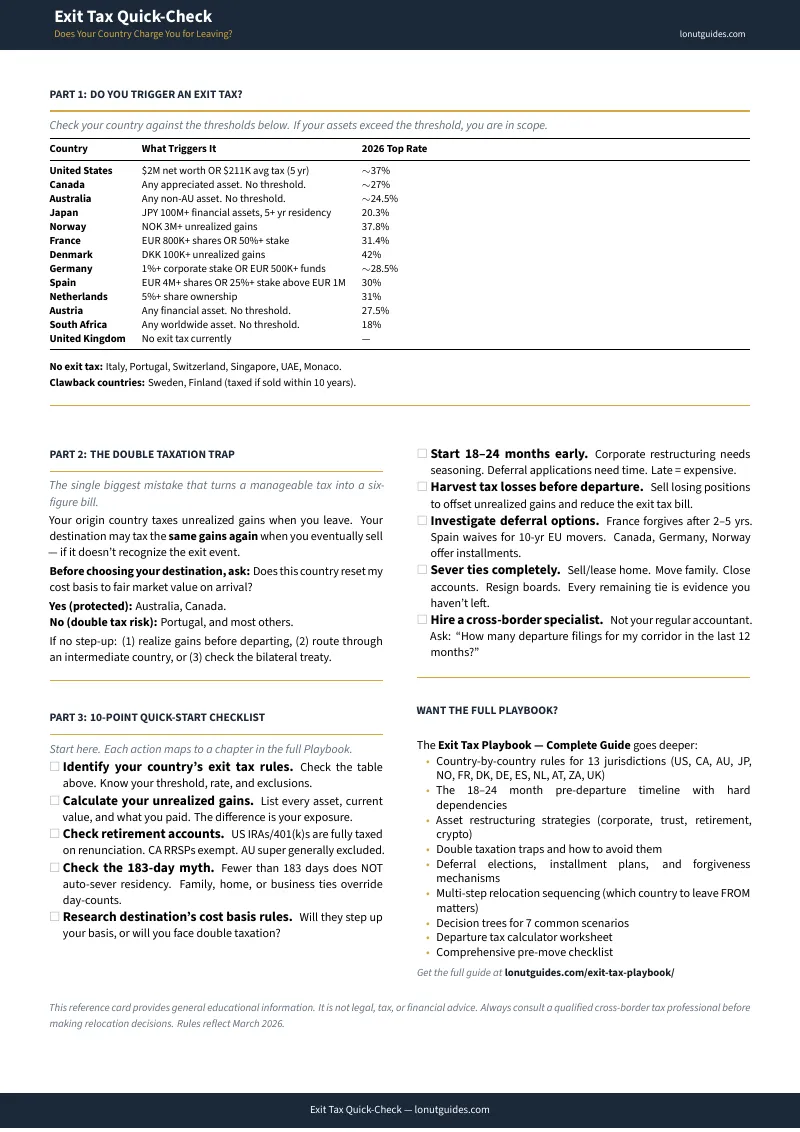
- Country Quick-Reference — all 13 countries' thresholds, rates, and deferral options on a single page for at-a-glance comparison
- Pre-Departure Timeline — the 18-24 month planning checklist as a standalone printable you can pin to your wall and check off step by step
The Free Exit Tax Quick-Check gives you a 1-page reference card covering which countries impose exit taxes, the trigger thresholds, and the single biggest planning mistake that turns a manageable tax into a six-figure bill. Use it to assess your exposure in 5 minutes.
— Less Than 10 Minutes of a Cross-Border Tax Advisor's Time
Cross-border CPAs charge $300-$500 per hour. Offshore advisory firms start at $10,000 for a basic planning engagement. Nomad Capitalist charges $50,000+ for comprehensive relocation execution. Most of that fee goes toward educating you on the fundamentals — what the rules are, what the timeline looks like, and what your options are.
This guide is the foundational layer. It gives you the framework so that when you do hire a specialist (and for complex situations, you should), you're paying them to execute strategy, not to teach you what an exit tax is. One avoided double-taxation event on a $500,000 portfolio saves you $75,000-$150,000. The return on isn't hypothetical.
What You'll Be Able to Do After Reading
- Know exactly whether your country charges an exit tax, what the threshold is, and whether you're above it
- Map out the 18-24 month pre-departure timeline with the specific asset restructuring steps in the right sequence
- Identify whether your planned destination creates a double taxation trap — and how to avoid it
- Evaluate whether deferral elections, spousal transfers, or intermediate jurisdictions reduce your exposure
- Calculate whether to realize gains before departure or defer them, based on origin vs. destination rates
- Handle retirement accounts, real estate, stock options, and crypto without triggering unnecessary taxable events
- Walk into a meeting with a cross-border tax advisor knowing the right questions to ask and the strategies to discuss
Satisfaction Guarantee
If this guide doesn't give you a clear, actionable plan for structuring your departure, email us and we'll refund you — no questions asked. We'd rather give you your money back than have you discover the double taxation trap after you've already moved.