Someone Owes You Money. Get It Back Through California Small Claims Court.
Your landlord pocketed your security deposit for "damages" that were normal wear and tear. A contractor took your money and disappeared. A driver hit your car and their insurance won't cover it. You know you're owed money — but the filing process feels like it was designed to make you give up.
The court website sends you in circles between forms with names like SC-100 and SC-104. Nobody explains which ones you actually need, how to fill them out, or what happens after you file. And even if you win, nobody tells you how to collect — the part where most self-represented plaintiffs get stuck.
This guide fixes all of that. It's a step-by-step filing kit that walks you through every stage — from sending your demand letter to collecting your judgment — in plain English, with California-specific forms, deadlines, and procedures.
Who This Is For
This guide is for anyone filing a claim in California Small Claims Court (up to $12,500 for individuals) who wants to handle it themselves:
- Tenants owed security deposits — your landlord has 21 days to return it under Civil Code 1950.5, and if they haven't, you have a strong case
- Contractor and service disputes — paid for work that was never finished, done poorly, or never started
- Car accident damage — the other driver's insurance denied your claim or lowballed you on the repair costs
- Unpaid debts — someone borrowed money and stopped responding
- Consumer disputes — defective products, services not rendered, or businesses that refuse to issue refunds
- Property damage — a neighbor, business, or service provider damaged something you own
California Small Claims Court does not allow attorneys to represent parties at hearings. You represent yourself — which is exactly why you need a guide that tells you what the lawyers already know.
What's Inside the Complete Guide
- Filing forms walkthrough — every required form (SC-100, SC-104, SC-103) with field-by-field instructions, which courthouse to file at, and the current filing fees by claim amount ($30-$75)
- Service of process guide — the 3 legal methods for serving papers in California, deadlines for each, proof of service forms, and what to do if you can't locate the defendant
- Court hearing preparation — how to organize your evidence, what the judge actually wants to hear, the structure of a typical hearing, common mistakes that lose winnable cases, and a day-of-court timeline
- Evidence organization worksheet — printable template for arranging photos, receipts, contracts, texts, and emails into a presentation the judge can follow in five minutes
- Post-judgment collection guide — what to do after you win, because winning and collecting are two different problems. Covers wage garnishment, bank levies, property liens, and when to use the Sheriff
- Statute of limitations reference — how long you have to file by claim type (2 years for oral contracts, 3 for property damage, 4 for written contracts)
- Common rejection reasons — the paperwork mistakes that get filings kicked back and cost you weeks of delay, including how to name business defendants correctly using the Secretary of State database
- County resources — filing fee schedule, fee waiver eligibility, and free Small Claims Advisory Service phone numbers
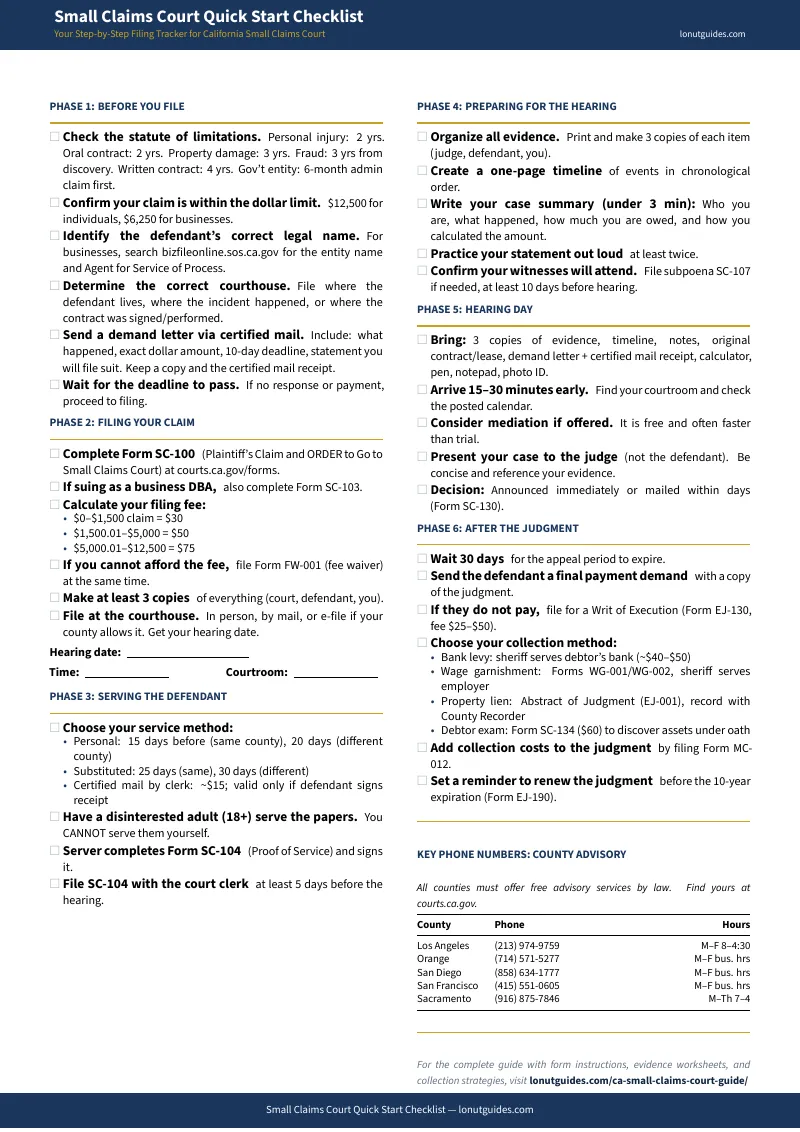
The Free Quick Start Checklist gives you a 1-page printable overview of the filing process — forms, deadlines, and fees at a glance. Use it to decide if you have a case and what to file first.
— Less Than Your Filing Fee
Paralegals charge $200+ to walk you through the same procedures. LegalZoom charges $149 and up. Nolo's book is 456 pages of information you mostly don't need for your specific case. This guide gives you the California-specific filing steps, form instructions, hearing strategies, and collection procedures — for less than the court charges to file your claim.
If you're trying to recover $1,500 to $12,500, spending on a guide that shows you exactly how is the smallest investment you'll make in your case.
What You'll Be Able to Do After Reading
- Fill out and file forms SC-100, SC-104, and SC-103 correctly — avoiding the common errors that get filings rejected
- Serve the defendant legally using one of three California-approved methods
- Walk into your hearing with organized evidence and a clear opening statement
- Understand the judge's decision process so you present your case in the format they expect
- Collect your judgment if the defendant doesn't pay voluntarily — using wage garnishment, bank levies, or property liens
- Know your statute of limitations so you file before your deadline expires
Satisfaction Guarantee
If this guide doesn't give you a clear path from filing to collection, email us and we'll refund you — no questions asked. We'd rather you get your money back from us than give up on getting your money back from the person who owes you.